CHAPTER 2: THE 2 A.M. KNOCK
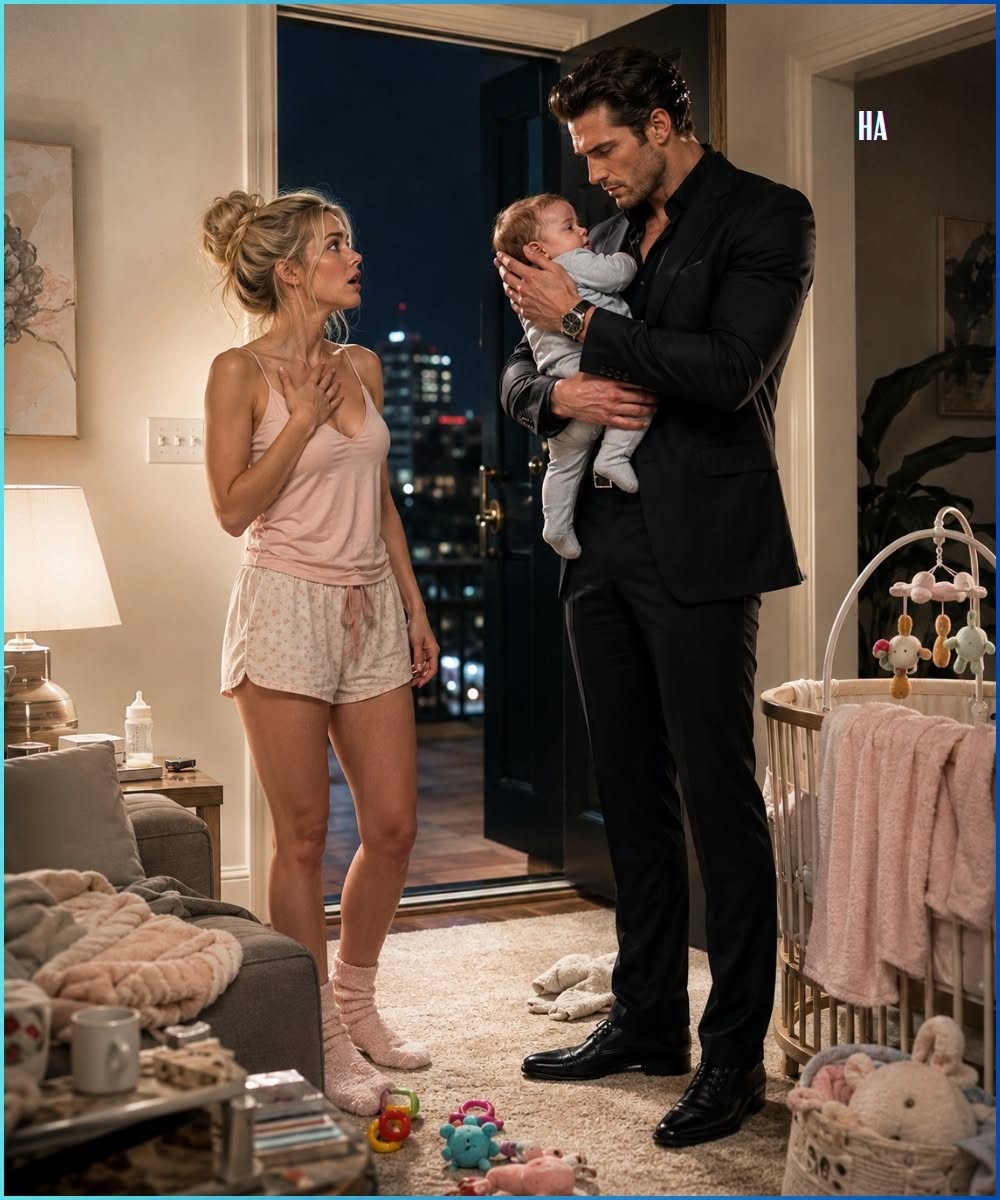
CHAPTER 2: THE 2 A.M. KNOCK
The tiny apartment on the edge of South Philadelphia always smelled faintly of cinnamon and old radiator steam. It was Madison’s sanctuary, a third-floor walk-up with mismatched furniture, a faded teal rug, and walls lined with colorful, laminated charts detailing routine schedules, emotional regulation colors, and visual timers. For two years, it had been just her and Noah against a world that rarely had the patience for a little boy who experienced life at triple the volume of everyone else.
Tonight, the volume was deafening.
It was exactly 1:45 a.m., barely twenty-four hours after the disastrous New Year’s Eve gala. Noah was in the throes of a massive, unstoppable sensory overload meltdown. The hospital visit from the night before had completely derailed his highly delicate, predictable routine. The stitches on his forehead were itching, the violent crackle of remaining neighborhood fireworks echoed outside the thin windows, and the sheer exhaustion of missed sleep had pushed his nervous system past the point of no return.
Noah was lying on his side on the living room rug, his small body rigid, his hands clamped tightly over his ears as he let out a high-pitched, rhythmic scream that tore straight through Madison’s soul. He wasn't crying tears; he was trapped in a neurological storm, unable to process the sensory inputs crashing into his brain.
"I know, sweetie, I know it hurts. The sounds are too big right now," Madison whispered, her voice cracking with a mixture of desperate love and pure exhaustion. She sat on the floor three feet away from him, her hands open in her lap, completely stationary. She knew better than to touch him right now. Touching an overstimulated autistic child during a meltdown was like throwing gasoline on a wildfire; it felt like physical pain to his hypersensitive skin.
Suddenly, a heavy, aggressive banging rattled the radiator pipe running along the wall.
"Shut that kid up!" a voice shouted from the apartment below, followed by another sharp, metallic thud against the ceiling. "Some of us have to work in the morning! He's too much! Call a doctor or put a gag on him!"
A hot, stinging tear slid down Madison's cheek. Too much. It was the phrase that had defined her son’s existence in the eyes of the world. The grocery store clerks who stared when he lined up cereal boxes, the playground moms who moved their children away when Noah flapped his hands in excitement, the daycare director who had gently but firmly asked her not to bring him back because he required "too much individualized attention."
Everyone thought he was too much. And tonight, Madison felt entirely alone in the dark, trying to hold together a world that was fracturing at the seams.
Then, at exactly 2:02 a.m., a knock sounded at her front door.
Madison froze. Her heart leaped into her throat, a sudden wave of panic replacing her exhaustion. Her neighbors usually just pounded on the walls; none of them ever came up to the third floor unless they were looking for a fight. She glanced at Noah, who was still humming a high, strained note against the rug, then slowly rose to her feet.
She walked to the heavy wooden door, her bare feet cold against the linoleum. She peered through the brass peephole, expecting to see her landlord or an angry tenant from downstairs.
Instead, the breath evaporated from her lungs.
Standing in the dim, flickering amber light of the narrow hallway was the man from the terrace.
He was still wearing the same black tuxedo from New Year’s Eve, though his silk tie was loosened around his collar, and a dark charcoal wool coat hung loosely over his broad shoulders. He stood perfectly still, his powerful frame occupying the entire width of the corridor. Even through the distorted glass of the peephole, his gray eyes looked impossibly sharp, burning with an intense, quiet focus.
Madison’s hands shook as she unlocked the deadbolt. She pulled the door open just a few inches, keeping the security chain engaged.
"You," she breathed, her voice barely a whisper against Noah’s distant screams. "How... how did you find me? Who are you?"
Lucas Marino didn't look angry about the chain. He didn't look surprised by the noise echoing from inside the apartment. He simply looked down at her, his gaze sweeping over her messy, tangled blonde hair, her oversized grey sweatpants, and the dark, violet shadows of exhaustion bruising the skin beneath her eyes.
"Your sister is very protective," Lucas said, his voice a deep, velvety baritone that instantly cut through the cold panic in Madison's chest. "But my people can be very persuasive when I require an address. Unlatch the door, Madison."
"I can't," she stammered, gripping the edge of the wood. "My son—he’s having a meltdown. He’s sick. It’s too loud in here, you shouldn't be here—"
"I know," Lucas cut her off gently, his gray eyes locking onto hers with a strange, immovable gravity. "That is exactly why I am here. Let me in."
There was something entirely irrational about what happened next. Every single safety rule Madison had ever learned told her to lock the door and call the police. This man was a stranger, a powerful, clearly dangerous individual who had tracked her to her private home in the dead of night. But as she looked into his eyes, she didn't see a threat. She saw the man who, forty-eight hours ago, had told her that any man who saw her son as a complication was an idiot.
With trembling fingers, she slid the chain out of the slot and opened the door wide.
Lucas stepped into the tiny apartment, his presence immediately shifting the molecular weight of the room. He closed the door behind him with a soft, decisive click, locking it without being asked. He didn't look at the modest furniture or the worn-out rug. His eyes went straight to the floor, where Noah was still curled into a tight ball, his small chest heaving as he let out another ragged sob.
Madison braced herself. She waited for the look of pity. She waited for the subtle recoil, the awkward clearing of the throat, the sudden realization that this was "too much" for a wealthy, powerful man to handle.
Instead, Lucas did something that left her entirely speechless.
He didn't hesitate. He took off his expensive charcoal wool coat, draping it over the back of a kitchen chair. He unbuttoned the cuffs of his white dress shirt, rolling the sleeves up to his elbows, revealing strong, tan forearms crossed by a faint, silver scar near his wrist.
Then, he walked over to the teal rug and dropped directly to his knees.
He didn't try to pick Noah up. He didn't speak in a loud, patronizing baby voice. Instead, Lucas sat cross-legged about two feet away from the boy, his large hands resting loosely on his knees. He lowered his head, settling into a posture of absolute, immovable stillness.
And then, he began to hum.
It wasn't a lullaby. It wasn't a children's song. It was a deep, low, resonant vibration that seemed to originate from the very center of his broad chest. The pitch was perfectly steady, a deep baritone hum that carried a rhythmic, heavy cadence—like the distant, soothing rumble of a powerful engine or the steady, deep thrum of a cello.
Madison watched from the kitchen doorway, her hand pressed hard against her mouth, her eyes wide with disbelief.
For the first two minutes, nothing changed. Noah continued to scream, his hands clamped over his ears. But Lucas didn't move a muscle. He didn't lose patience. He kept humming, his deep, steady vibration cutting through the chaotic, frantic noise of the apartment like a physical anchor.
Slowly, incredibly, Noah’s screaming began to falter.
The boy’s high-pitched wails turned into sharp, hitching gasps. He shifted on the rug, his small ears twisting toward the sound of Lucas’s chest. The deep, low frequency of Lucas’s humming was doing something Madison’s voice hadn't been able to achieve all night; it was providing a singular, predictable auditory focus that was actively grounding Noah’s overstimulated nervous system.
Noah slowly unfolded his arms. He turned his head, his tear-streaked face looking up at the large, dark-haired stranger sitting on his floor. Noah’s wide, brown eyes—usually so unfocused during a meltdown—locked directly onto Lucas’s face.
Lucas didn't smile, and he didn't break his gaze. He simply lowered the pitch of his hum, turning it into a soft, steady rhythm that matched the speed of Noah’s frantic breathing.
Noah crawled forward. He moved like a small, cautious animal, his knees dragging across the teal wool until he was inches away from the mafia boss. He reached out one tiny, trembling hand, his small fingers touching the fabric of Lucas’s expensive black trousers, then tracing upward until his palm rested flat against the center of Lucas’s broad chest—right where the deep, soothing vibration was strongest.
Lucas stayed completely still, allowing the little boy to explore his space, to feel the physical weight of his calm.
"Strong," Noah whispered, his voice small, raspy, and incredibly fragile. It was the first coherent word he had spoken in nearly six hours. "Like... like a big boat."
The corner of Lucas’s mouth lifted in a fraction of a smile, the intense, dangerous shadows of his face softening into something so profoundly gentle it made Madison’s knees weak.
"Yes," Lucas said softly, his deep voice carrying that same steady vibration. "Like a big boat, Noah. The storm cannot flip us over. We are too heavy."
Noah let out a long, shuddering sigh. The absolute exhaustion of the night finally caught up to him. Without a single word, the little boy leaned his entire weight forward, his head collapsing directly onto Lucas’s lap, his small fingers curling into the fabric of Lucas's shirt. Within thirty seconds, his eyes fluttered shut, his breathing turning deep, even, and entirely peaceful.
Madison leaned against the kitchen counter, the tears she had been holding back for hours finally spilling over her cheeks in silence. For four years, she had been the only one holding her son through the dark. She had been the only one who didn't run when the noise became too loud.
And now, a man who looked like he could order the destruction of a city with a single phone call was sitting on her living room floor, acting as a human weighted blanket for her sleeping child.
May you like



Lucas looked up from Noah’s sleeping form, his gray eyes catching the soft lamplight of the room. He didn't move, not wanting to disturb the boy, but his gaze pinned Madison to the spot.
"He is not too much, Madison," Lucas whispered, his voice carrying a quiet, lethal weight that echoed through the quiet apartment. "The world is simply too small for him."







