Chapter 2 - The Weight of the Badge
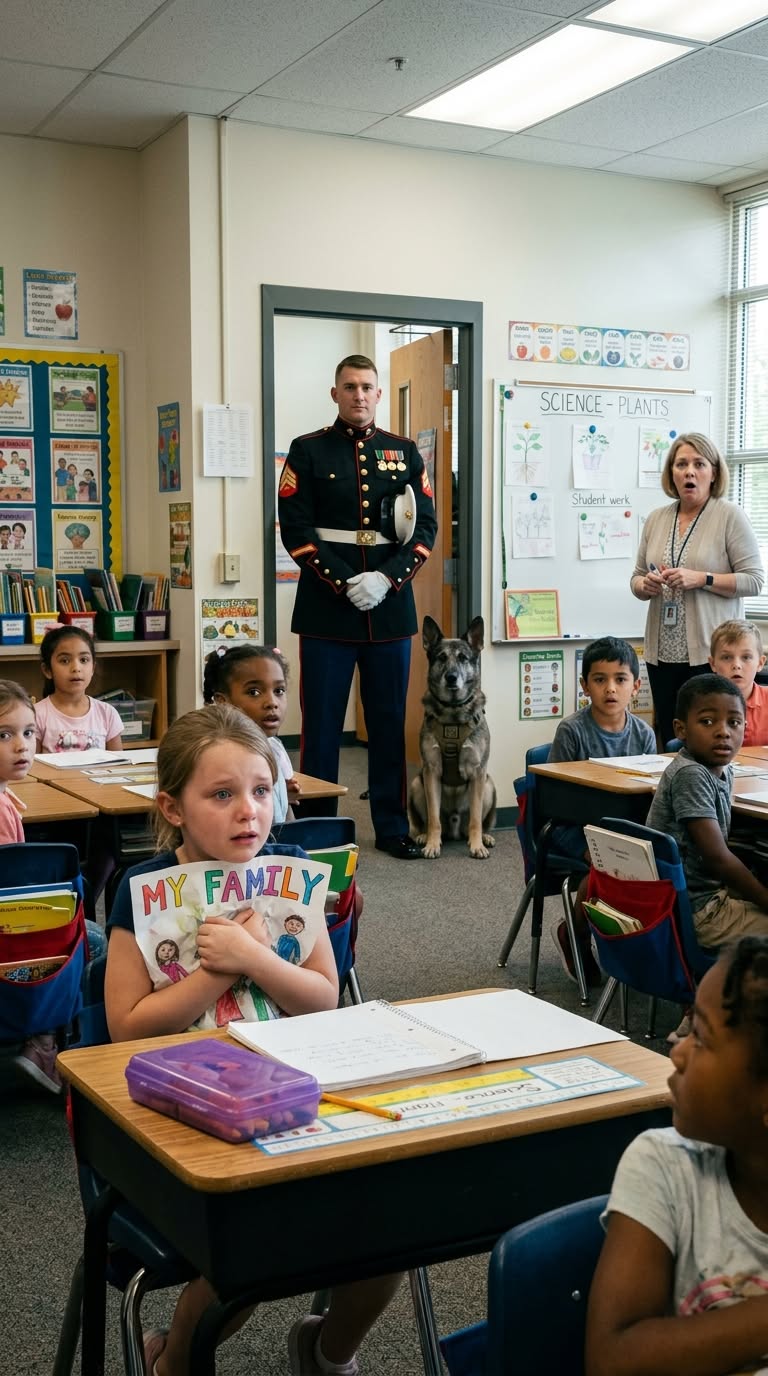
The silence in the classroom was a heavy, suffocating thing. Mrs. Pennington’s hand hung frozen in the air, still holding a piece of blue chalk that hovered an inch from the whiteboard. The word she had been writing—Community—remained half-finished, the letter 'm' trailing off into a jagged streak where her wrist had jumped.
I didn’t look at her immediately. I kept my gaze leveled at the twenty-four pairs of wide, unblinking eyes staring up from small plastic desks. Eight-year-olds are intuitive creatures; they don’t understand the geopolitics of a deployment or the bureaucratic machinery of the United States Marine Corps, but they understand power. They understand when an adult is truly angry, and they understand when the rules of their small, predictable world have just been rewritten.
Max remained perfectly still by my left knee. His harness, a heavy-duty tactical vest made of faded coyote-brown nylon, bore the scorched patches of the 3rd Battalion, 5th Marines. On his flanks, the words MILITARY WORKING DOG were embroidered in bold, blocky letters, right beneath a tarnished bronze star that had been pinned through the webbing. He was a Belgian Malinois, lean and muscular, his coat the color of dried earth, with a black mask that made his amber eyes look like twin embers burning through the classroom’s fluorescent glare.
"Mr. Whitaker," Mrs. Pennington finally managed to say. Her voice was thin, a sharp contrast to the booming authority she had undoubtedly used the day before when dismantling my daughter’s pride. She set the chalk down on the tray, her fingers trembling just enough to make the small stick rattle against the metal. "This is... unexpected. We are currently in the middle of our morning social studies unit. Visitors are typically cleared through the main office."
"I was cleared, Mrs. Pennington," I said. My voice wasn't loud. I used my command presence—the quiet, gravelly baritone that carries across a windy tarmac or a chaotic command post without ever needing to rise to a shout. "Principal Vance checked my ID and my orders five minutes ago. He agreed that a living history lesson was exactly what this curriculum was missing."
I took three steps forward. The heavy soles of my corfam dress shoes clicked against the linoleum with measured, metronomic precision. Every child's head tracked my movement, save for Lila, who sat in the front row. She was leaning back in her chair now, her small hands resting on the edges of her desk, her chest rising and falling with a rhythmic, proud steadiness that hadn't been there when she walked out of our house.
I stopped right beside the teacher's desk. On it sat a neat stack of graded papers, a apple-shaped paperweight, and a small, laminated card that read: In this classroom, we practice equity and objective truth.
"Lila," I said, looking down at my daughter. "Where is the poster?"
With careful, deliberate movements, Lila reached into her backpack and pulled out the crushed sheet of poster board. The edges were frayed, and the heavy crease running through the center had nearly torn the photograph of Max in half. She stood up, held it out to me, and then sat back down without a word.
I unfolded it, smoothing the thick paper against the chalkboard behind Mrs. Pennington. The teacher took a step back, her back pressing against the wall, her eyes darting toward the open door as if hoping the principal would appear to rescue her from the reality she had manufactured.
"Yesterday," I began, turning back to the class, "Lila was told that calling her father a hero wasn't 'objective.' She was told that wearing a uniform doesn't make a person a fact. And she was right. A uniform is just cloth. It’s dye and thread. You can buy it at a surplus store for forty dollars."
I hooked my thumb under the heavy brass buckle of my dress belt.
"But what happens inside the uniform... that is a fact. And today, we’re going to talk about facts."
I looked at a small boy in the second row who was staring intently at the silver medals pinned to the left breast of my jacket. "What’s your name, son?"
"T-Toby," the boy whispered, his knuckles white around his yellow pencil.
"Well, Toby, do you know what this blue ribbon with the silver stars is?" I asked, pointing to the top row of my ribbon rack.
Toby shook his head, his eyes widening.
"This is the Navy and Marine Corps Medal," I said. "You get this when you save someone's life while risking your own. But I didn't win it. Max did."
A collective gasp rippled through the small desks. A few children leaned over their chairs to get a better look at the dog sitting quietly by my side. Max, sensing the shift in attention, raised his head slightly, his ears pricking forward, his eyes locked onto mine, waiting for the command that would tell him his watch was over.
"Six years ago, in a place called Helmand Province," I said, the names of the foreign dirt tasting like copper in my mouth, "it was one hundred and fifteen degrees outside. There were no trees. There were no air conditioners. There was just sand, rock, and people who wanted to hurt us. Max and I were walking down a path no wider than this aisle between your desks. My job was to lead the men. Max's job was to find what was hidden."
I stepped closer to Mrs. Pennington, my shadow falling completely over her small oak desk.
"He found it," I continued, my voice dropping an octave, becoming cold and heavy as iron. "A buried explosive device. It was three inches beneath the dirt, wired to a pressure plate. If I took one more step, my daughter wouldn't have a father to drive her to school today. Max didn't run. He didn't bark. He didn't ask for a reward. He just sat down right on top of it, shielding the plate with his own body until the engineers could defuse it."
May you like



I looked directly into Mrs. Pennington’s eyes. Her face had gone from pale to a dull, mottled gray.
"That is a fact, ma'am," I murmured. "And it’s a very objective one."







