Chapter 2 - The Audacity of Broth
The memory of that old porcelain pot of stew was what finally moved Annie’s feet. She remembered how her grandmother hadn't said a word about grief, hadn't told her to be strong for Noah, and hadn't begged her to take a bite. She had simply set the heavy pot down, cracked the lid to let the steam fill the cold kitchen, and handed Annie a chipped ceramic spoon.
Food wasn't an argument. It was a bridge back to the living.
Annie looked at the kitchen doors of The Gold Finch. Behind them stood Chef Morimoto, a man whose culinary lineage stretched back to Tokyo’s imperial hotels. He was currently leaning against a steel prep table, his head buried in his hands, his immaculate white chef’s whites pristine, yet his spirit entirely crushed. He had sent out four masterpieces tonight, and four masterpieces had returned to his kitchen like insults wrapped in silver foil.
Annie walked past him without a word. She didn't ask for permission. If she had asked, the manager would have fired her on the spot, and Chef Morimoto would have lectured her on the sacred protocols of gastronomy.
She walked over to the dry storage shelves, her white sneakers squeaking softly on the linoleum. She didn't reach for the imported truffles, the dried abalone, or the gold-flecked sea salt. She reached for a simple, clear jar of short-grain Koshihikari rice. She grabbed a single yellow onion, a piece of ginger no larger than her thumb, a bundle of green scallions, and a small container of home-style white miso paste—not the dark, triple-aged ceremonial variety Morimoto used, but the sweet, comforting kind normal families bought at the U-Uwajima market in the International District.
In the back corner of the stove, away from the roaring burners meant for searing high-grade meats, Annie filled a small, battered copper pot with cold water.
Chef Morimoto looked up, his brow furrowing as he watched the nineteen-year-old server wash the rice in a colander. "Miller," he said, his voice gruff with exhaustion. "What are you doing? The kitchen is closed. Mr. Kato is preparing to leave."
"He hasn't left yet, Chef," Annie said softly, her eyes focused on the water turning milky-white as she rinsed the grains. "And he can't leave like this."
"If he will not eat my roasted duck or the A5 strip, he will not eat whatever it is you are playing at," Morimoto snapped, turning his back. "You are wasting your time. More than that, you are risking your job. The Kato family does not tolerate foolishness."
Annie didn't answer. She set the rice to boil, watching the water rise and fall in steady, rhythmic bubbles. While it cooked, she took the ginger and charred it directly over an open flame until the skin was blackened and aromatic, releasing a sharp, warm scent that cut through the heavy, expensive smell of duck fat in the kitchen. She dropped the charred ginger and the halved onion into a second pot of light dashi broth, letting the liquid simmer until it turned the pale, translucent amber of autumn leaves.
She didn't use a knife for the chicken. She took a small piece of leftover cold roasted chicken from the prep fridge and tore it into delicate, ragged shreds with her fingers—the way her grandmother did when Annie had the flu. It wasn't elegant. It didn't look like art. It looked like home.
When the rice was perfectly soft, almost blooming into a thick porridge, she ladled the ginger-infused dashi over it, swirling in a single tablespoon of the sweet white miso until it dissolved completely. She topped the bowl with the shredded chicken, a handful of finely slivered green scallions, and a single drop of toasted sesame oil.
It was a bowl of okayu—rice gruel. The simplest, most unpretentious food in the Japanese language. The food given to sick children, to the elderly, and to those whose souls were too weary to chew.
Annie placed the heavy ceramic bowl onto a plain wooden tray. She didn't add a linen napkin or a silver spoon. She found an old, mismatched wooden spoon in the utility drawer and set it beside the bowl.
As she pushed the double doors open, the manager, Mr. Tanaka, intercepted her, his face turning an alarmed shade of white. "Annie! What is that? What are you doing? Take that back immediately. Mr. Kato’s security is already moving toward the table."
"Let her pass," a low voice called out from the back of the room.
It wasn't Kenji who spoke. It was Hannah Kato. She was standing by the booth, her cream silk coat already draped over her arm, her sharp eyes locked onto the simple wooden tray in Annie's hands. Hannah had spent four days watching her brother disappear, and while she cared about the empire, she also knew that a dead boss couldn't sign executive orders. She saw the audacity in the nineteen-year-old's eyes, and for the first time all night, Hannah looked intrigued.
Annie walked past the manager, her heart hammering against her ribs like a trapped bird. Every step felt like she was wading through wet cement. The dark-suited security men watched her, their hands resting flat against their jackets, their eyes tracing her movements with lethal precision.
She reached the back booth.
Kenji Kato didn't look up. He was still staring at the empty leather seat across from him, his long, scarred hands flat on the polished oak table. The smell of his sister's perfume hung in the air, cold and expensive.
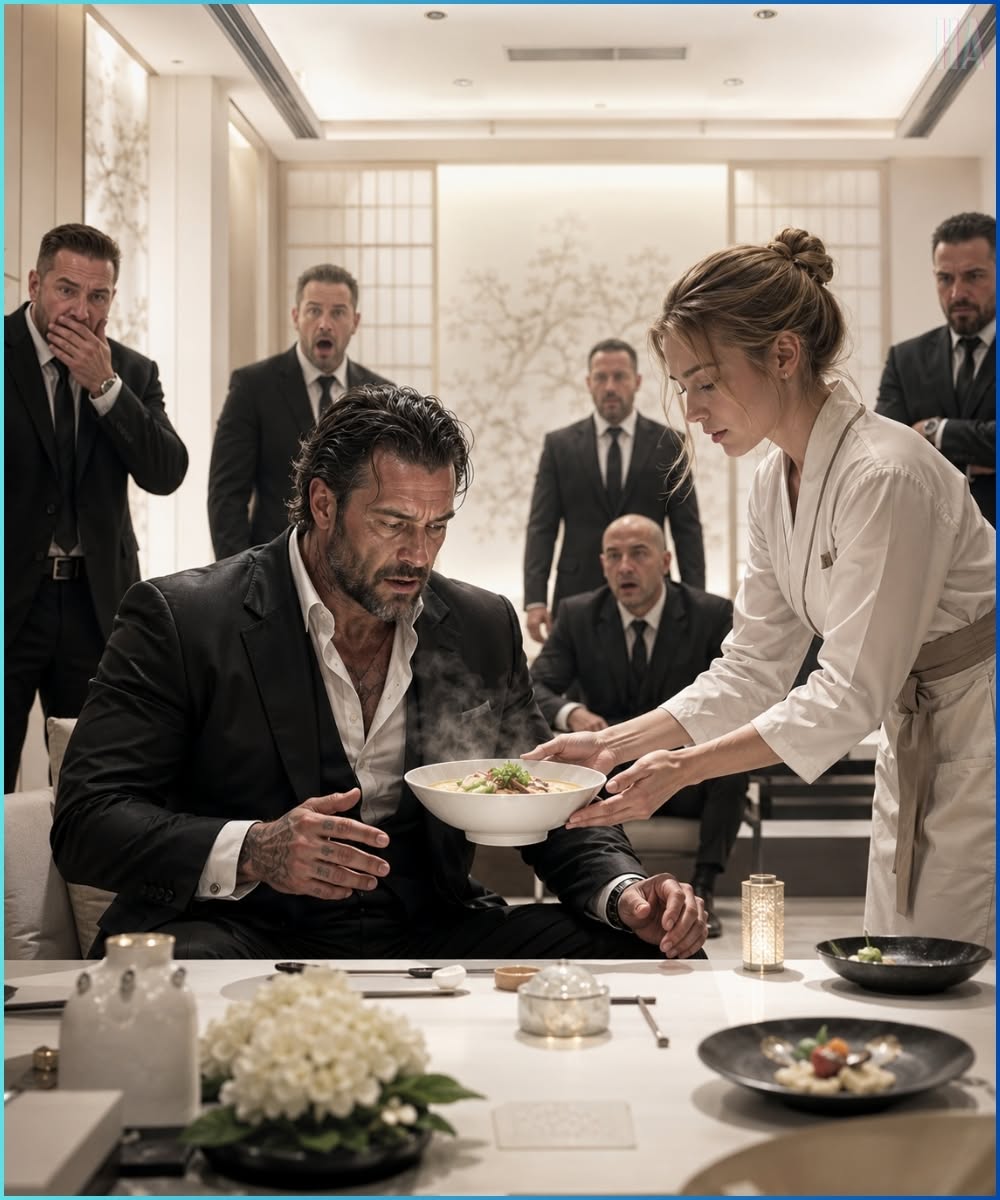
Annie didn't say Good evening, sir. She didn't ask if he wanted fresh water. She simply set the wooden tray down, removing the plate of untouched Wagyu beef to make room for the steaming bowl of rice porridge.
The sharp, warm scent of charred ginger and toasted sesame oil rose from the bowl, instantly cutting through the heavy atmosphere of the café. It was an aggressive smell, not because it was loud, but because it was intensely familiar. It was the smell of a kitchen in the winter, of a mother standing over a stove, of a time before the docks and the money and the blood.
Kenji’s hand twitched.
His eyes, heavy-lidded and dark with four days of sleeplessness, slowly shifted from the empty chair to the bowl. He stared at the ragged pieces of chicken, the simple green scallions, the pale, humble rice.
"What is this?" he asked. His voice was a low growl, like stones grinding together at the bottom of the sea.
"It’s okayu, sir," Annie said, her voice small but remarkably steady. She stood at the edge of the table, her hands tucked into the pockets of her blush-pink server dress. "You don't have to chew it. You just have to swallow."
Hannah Kato drew a sharp breath. One of the security men took a step forward, his fingers twitching toward his lapel. To give instructions to Kenji Kato on how to eat was an offense that usually resulted in a man being carried out the back door.
Kenji looked up. For the first time in four days, his flint-like eyes focused on a living person. He looked at Annie—at her messy brown bun, her oversized apron, the honest blue eyes that didn't hold a single drop of fear, only a profound, quiet understanding of what it meant to starve in the dark.
"Who told you to bring this to me?" Kenji asked.
"No one, sir," Annie said. "Your food looked cold. And your hands are shaking."
The silence that followed was absolute. Hannah looked at her brother, her breath held, waiting for the storm to break. Kenji Kato was a man who had ordered executions for lesser insults.
But Kenji didn't roar. He looked back down at the bowl. The steam hit his face, warming his gray, exhausted skin. Slowly, with a deliberate, painful effort that looked like he was lifting a boulder, he reached out his right hand. His fingers, scarred from a youth spent on the violent streets of Osaka, wrapped around the wooden spoon.
He lifted a single, small spoonful of the warm porridge to his lips.
He swallowed.
The warmth hit his throat, traveling down to his empty, knotted stomach like a physical light. The taste of the sweet white miso and the sharp ginger didn't taste like luxury; it tasted like survival. It tasted like the small apartment he had shared with his mother before the gangs took him. It tasted like the simple humanity he had spent twenty years trying to protect Maya from.
Kenji closed his eyes. A single, heavy breath escaped his lungs—a sound that sounded terribly like a sob, though no one in the room would ever dare use that word.
He took a second spoonful. Then a third.
By the fifth spoonful, he was eating with a quiet, desperate hunger, his head bowed over the simple ceramic bowl as if it were the only solid thing left in a world that had dissolved into smoke.
Hannah Kato stepped back, her hand coming up to touch her pearl earring, her sharp eyes wide with an absolute, stunned disbelief. The security men relaxed their shoulders, their faces remaining blank, but their eyes tracking Annie with a new, sudden terror.
May you like



Annie didn't wait for him to finish. She didn't ask if it tasted good. She turned around, her white sneakers squeaking on the oak floor, and walked back toward the kitchen doors, her apron strings swaying behind her.
Behind her, at the back table of the empire, the boss was finally eating.







