“Don’t embarrass me,” my sister whispered, her smile frozen in place for the benefit of the room. “My fiancé’s father is a federal judge.”
She said it as if I might not understand what those words meant.
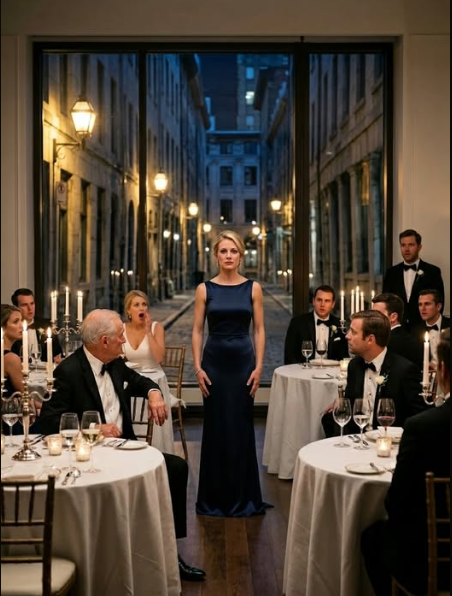
Across the private dining room of the Jefferson Hotel, crystal glasses caught the soft amber light from the chandeliers. White linen fell in perfect lines over the long table. A string arrangement played quietly through hidden speakers. Waiters moved as silently as shadows between people who had spent their whole lives expecting the world to make room for them.
My sister, Victoria Monroe, stood beside me in a champagne-colored dress that cost more than my first car. Her blond hair was swept into an elegant twist, her diamond earrings trembled every time she turned her head, and her hand was wrapped tightly around the arm of Mark Reynolds, the man she intended to marry before the year was out. She looked polished, luminous, and terrified.
Not terrified of marriage. Not terrified of love. Not even terrified of the powerful people gathered to celebrate her engagement.
She was terrified of me.
Or, more accurately, terrified of the version of me she had invented and spent fifteen years presenting to anyone who would listen.
“Elena,” she continued, still smiling at an elderly woman in pearls who was watching us from the other side of the room, “I need you to just be normal tonight. Pleasant. Quiet. Don’t talk about your job too much. Don’t mention government work. If anyone asks, say you’re in law. That’s technically true.”
I looked at her. “Okay, Victoria.”
“And please,” she said, lowering her voice further, “don’t make jokes about money. Don’t get defensive. Don’t tell any weird stories about whatever cases you file papers for. These people are sophisticated. They won’t understand your… lifestyle.”
“My lifestyle.”
“You know what I mean.”
I did know what she meant. I had known what Victoria meant since we were children and she discovered, very early, that there was power in defining someone before they could define themselves.
In Victoria’s world, I was the disappointing younger sister. The quiet one. The one who wasted her law degree on a low-level government career. The one who lived modestly because she had never learned how to succeed. The one who drove a practical sedan, wore simple suits, avoided social media, and showed up at family events without a husband, without children, without a title worth bragging about.
That was the story Victoria liked. It had become useful to her. It allowed her to be the beautiful one, the successful one, the polished one, the sister who had escaped ordinary life and married well and moved in circles where people knew the difference between old money and new money. Every family needs a comparison point. For Victoria, I had always been that point.
So I stood beside her in a dark blue dress I had owned for years, my hair pinned neatly at the nape of my neck, wearing the small pearl earrings I kept for formal occasions, and I let her believe I was nervous.
“I’ll be on my best behavior,” I said.
Victoria exhaled through her smile. “Thank you. I mean that. Tonight matters.”
Across the room, Mark Reynolds laughed at something his mother said. Mark was handsome in the careful way men become handsome when they are raised around good tailoring and automatic confidence. He was thirty-eight, a senior associate at a white-shoe law firm in Washington, D.C., and he possessed the relaxed charm of a man who had never had to prove he belonged anywhere. His father, Judge Thomas Reynolds of the United States Court of Appeals for the Fourth Circuit, stood near the fireplace with a glass of club soda in his hand, speaking to a retired senator and a university president.
I knew Judge Reynolds well.
That was the part Victoria did not know.
She had spent months warning me about the Reynolds family as if they were foreign royalty. She had explained the structure of the federal courts to me as if I had not spent thirteen years sitting on one. She had told me, with great seriousness, that a circuit court judge was “basically one step below the Supreme Court,” and I had only said, “Yes, I know.” She had told me that Mark’s father had clerked for a Supreme Court justice, that Mark’s mother had studied at Oxford, that their family vacationed in Nantucket, that they knew senators personally.
I had listened to every update. I had congratulated her when appropriate. I had let silence do what silence had always done in our family: protect me from turning every conversation into a trial.
But as I stood in that private dining room and watched Judge Reynolds turn from the fireplace, his eyes moving across the guests until they landed on me, I understood that silence had reached the end of its usefulness.
His face changed.
Not dramatically. Judge Reynolds was too disciplined for that. But recognition moved through his expression like light moving behind a curtain. His eyebrows lifted. His mouth softened into surprise. He set down his glass.
Victoria was still speaking.
“Mark’s mother is going to introduce you to a few people,” she murmured. “Just remember, you’re not here to impress anyone. You’re here because you’re my sister, and I need you to make a decent impression by not trying too hard.”
Judge Reynolds began walking toward us.
I could have warned her.
There was a moment, brief but real, when I could have turned to Victoria and said, “You should know something before this happens.” I could have spared her the public shock. I could have stepped out into the hall and told her everything. I could have said my full title quietly, privately, mercifully.
But then she tightened her grip on my arm and whispered, “And please don’t mention that sad little government salary thing. Mark’s family doesn’t need to know everything.”
That was when I decided to let the room do what I had refused to do for fifteen years.
Let it tell the truth.
Judge Reynolds reached us with his hand already extended. He did not look at Victoria first. He looked directly at me, warm and formal and unmistakably respectful.
“Your Honor,” he said, “it’s good to see you again.”
Victoria’s wine glass slipped from her hand.
It hit the hardwood floor and shattered.
The sound cracked through the dining room, bright and violent, cutting off every conversation at once. Red wine spread beneath her heels like a stain blooming in slow motion. Mark turned. His mother turned. A waiter froze halfway between the wall and the table. Someone gasped.
Victoria stared at Judge Reynolds, then at me, then back at Judge Reynolds. Her face had gone perfectly still except for her mouth, which opened slightly, as if her mind had reached for a sentence and found nothing there.
I looked at the broken glass.
Then I looked at my sister.
And because some truths deserve to be spoken cleanly, I said, “Good evening, Judge Reynolds.”
Victoria gave a small laugh. It was high, brittle, almost childlike.
“I’m sorry,” she said. “Your Honor? That’s funny. Elena, did you not tell me you knew Mark’s father?”
Judge Reynolds looked confused. “I assumed you knew.”
Victoria blinked. “Knew what?”
Mark stepped closer. “Dad?”
Judge Reynolds glanced at me, then at Victoria, then back at me. I could see him realizing, much too late, that he had walked into a family arrangement built entirely on concealment and contempt.
I smiled faintly, not because anything was funny, but because composure had become a language I spoke better than English.
“I’m Judge Elena Monroe,” I said. “United States District Court for the Eastern District of Virginia.”
The room went silent in a different way then.
The first silence had been shock. This one was recalculation.
Victoria stared at me as if I had removed my face and revealed someone else beneath it. Mark’s expression shifted from confusion to recognition to alarm. His mother, Margaret Reynolds, whose manners were sharp enough to cut fruit, placed one hand lightly over her pearls. The retired senator near the fireplace leaned forward, suddenly interested. A young associate from Mark’s firm whispered something to his wife.
My sister’s engagement dinner did not fall apart all at once. That would have been too simple. It began to unravel thread by thread, with everyone watching the first loose string appear in Victoria’s hand.
May you like



But to understand the look on her face when Judge Reynolds called me “Your Honor,” you need to understand that it had been fifteen years in the making.
I was born Elena Grace Monroe, forty-two years ago, in Arlington, Virginia, into a family that looked, from the outside, like a success story polished for suburban magazines. My father, David Monroe, and my mother, Caroline, owned a thriving accounting firm that served small businesses, doctors, contractors, and enough politically connected clients to give my parents the feeling that they were adjacent to importance. We lived in a large brick house with white columns, went to a Presbyterian church with a waiting list, belonged to a country club my father pretended not to care about, and spent every Thanksgiving with people who measured children by their college admissions before asking whether they were happy.