My Son Shouted That I Couldn’t Disrespect His Wife In Her Own House,
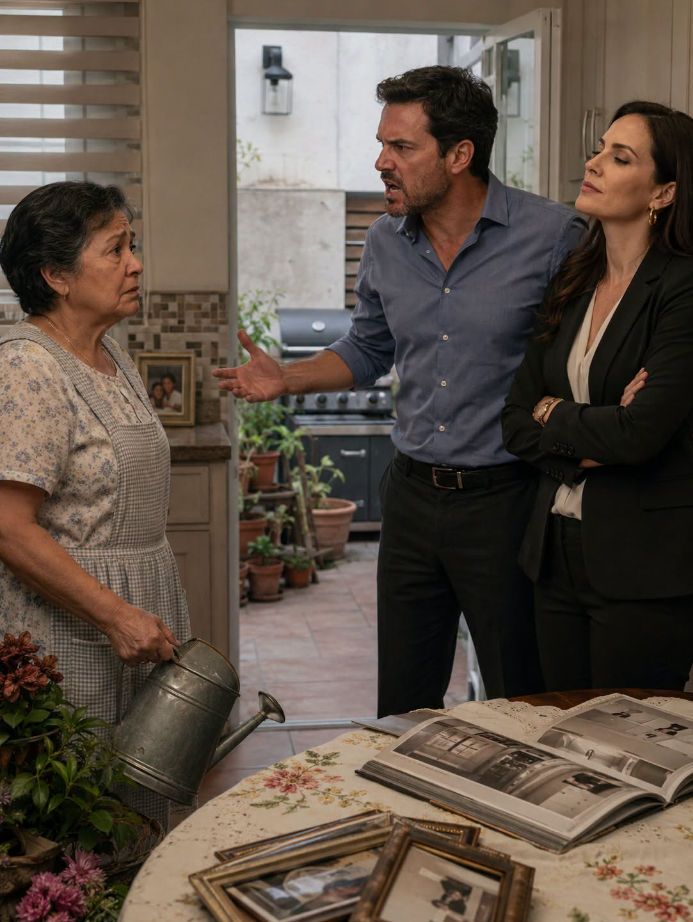
My Son Shouted That I Couldn’t Disrespect His Wife In Her Own House, Though It Was Mine. I Had Built Every Room With Forty Years Of Sewing, Saving, Grief, And Quiet Sacrifice After Widowhood Alone. Then My Daughter-In-Law Moved My Plants, Changed My Curtains, And Turned My Home Against Me Completely Slowly. For Months Ricardo Called Me Difficult While Cristina Played Victim In The Kitchen I Had Paid For. But When She Touched The Backyard Flowers His Father Once Gave Me, Something Inside Me Went Still. That Sunday, I Realized Loving My Only Son Could No Longer Mean Disappearing Inside My Own House.
Part 1....
“You are not going to talk to my wife like that in her own house.”
My son’s voice thundered through the small kitchen so sharply that, for one moment, I forgot I was holding a watering can. The metal handle pressed against my fingers, the floor felt too cold beneath my shoes, and the plants near the window stood silently between us like witnesses that could not speak.
His wife stood behind him with her arms folded, chin raised, eyes dry and bright. Cristina looked wounded in the exact way she always looked wounded when Ricardo was watching, as though every word I said became cruel only because she knew how to receive it.
I stayed frozen beside the sink.
Tears climbed into my throat, but I swallowed them one by one because I had spent too many years learning that crying in front of people who wanted control only gave them another tool. In that instant, I looked at the man standing before me and saw, not my son, not the baby I had carried through fevered nights, not the young man whose diploma I once held with shaking hands, but a stranger defending another woman’s claim over the house I had built with my own hands.
That was the moment I understood something I had been refusing to name.
If I wanted respect inside my own home again, I would have to make a decision that might cost me the only son I had.
My name is Lucia Ramirez. I am sixty-seven years old, and for most of my life, I believed love meant endurance.
I learned endurance early. My husband, Gabriel, passed away when Ricardo was still young enough to ask why his father’s work boots stayed by the door if he was never coming home. I had no answer that would not break both of us, so I held him, kissed his hair, and promised him we would survive.
Then I went to work.
For forty years, I worked as a seamstress in San Antonio, Texas, taking in hems, adjusting wedding dresses, repairing uniforms, shortening curtains, and stitching other people’s lives together while mine quietly frayed at the edges. My hands grew stiff from needles, my back bent from leaning over fabric, and my eyes learned to work late under a single kitchen lamp when bills arrived before paychecks did.
Every dollar I saved went into my house.
Not a mansion. Not anything grand. Just a warm little home with cream walls, tile floors, a front porch wide enough for two chairs, and a backyard filled with potted plants that made every hard year feel like it had still produced something alive.
I built that house slowly. Brick by brick. Payment by payment. Sacrifice by sacrifice.
When Ricardo graduated as an engineer, I cried so hard during the ceremony that a woman behind me handed me tissues. I remember watching him walk across the stage in his cap and gown, tall and proud, and thinking that every sleepless night had been worth it. Every meal I skipped, every dress I patched instead of replacing, every Saturday I spent sewing while other women rested, all of it had carried us to that moment.
My son had made it.
I thought that meant I could finally breathe.
Then Cristina entered our lives.
Ricardo met her at a company party, and after only six months of dating, he announced they were getting married. She was beautiful in the polished way that makes people look twice, with glossy hair, sharp perfume, and a smooth voice that seemed trained to sound sweet even when her eyes stayed cold.
She was ten years younger than Ricardo and worked in marketing, which she mentioned often enough for me to understand that she believed it placed her above certain ordinary things. Cooking. Cleaning. Asking permission. Respecting the woman whose house she was entering.
Everything happened too quickly.
Before I had time to understand who she was, we were sitting in my living room discussing how Ricardo and Cristina would live with me temporarily until they saved enough to buy their own place.
“It will be perfect, Mom,” Ricardo said, leaning forward with that excited smile that still made me weak. “We can save faster, and you won’t be alone.”
Cristina sat beside him with one hand resting on his knee. Her smile was beautiful. Her eyes were not.
“That sounds practical,” she said.
Practical.
Not kind. Not grateful. Not generous.
Practical.
Something inside me tightened, but I ignored it because mothers are very good at lying to themselves when their children look happy. I told myself I was being old-fashioned, nervous, too protective. I told myself that a new marriage needed space to grow and that perhaps this arrangement could be good for all of us.
The first sign came during the first week after the wedding.
I returned from visiting my friend Silvia and found all my flower pots rearranged on the balcony. My succulents, which needed direct sun, had been pushed into a shaded corner near the wall, while the best sunny spot now held a new metal coffee table with glass edges and cold silver legs.
For fifteen years, that corner had belonged to my plants.
Some had been gifts from neighbors. Some had been cuttings from Gabriel’s mother’s garden. Some had survived droughts, storms, and seasons when I barely had time to care for myself, much less anything else.
“Cristina, dear,” I said carefully, setting my purse down. “These plants need sun. They won’t do well in that corner.”
She did not even lift her eyes from the magazine in her lap.
“They were making the balcony look crowded,” she said. “We needed space for the coffee table I bought.”
I looked at the table.
It was expensive, I’m sure, but it did not belong there. It looked like something from a hotel lobby, sharp and shiny and completely out of place against the warm walls, clay pots, and woven chairs I had chosen over the years.
“You should have asked me first,” I said.
That was when Cristina finally looked up.
Her expression was calm, but underneath it sat something hard and bored. “Ricardo said it would be fine. This is our house now too, right?”
Our house.
The words landed softly, but they did not leave softly.
That night, I spoke to Ricardo while Cristina was upstairs.
“Son,” I said, “I wish Cristina had asked before moving my plants. Some of them are delicate.”
Ricardo shrugged while scrolling through his phone. “Mom, she’s just trying to add her touch. Don’t make it a big thing.”
I wanted to say it was already a big thing because I had not been asked. I wanted to say that adding her touch should not mean erasing mine.
But I looked at my son’s tired face and swallowed the words.
That became the pattern.
The curtains I had sewn myself were replaced with metallic blinds that made the living room feel colder. My family photographs were removed from the shelves and packed into a box to make room for modern decorations Cristina said looked “cleaner.” The kitchen I had organized for decades was rearranged so that pots, pans, and spices were placed on shelves too high for me to reach without dragging over a chair.
Every time I questioned a change, Ricardo became more impatient.
“Mom, you have to be flexible,” he would say. “Cristina lives here now.”
Yes, she lived there.
But I owned it.
What wounded me most was not even the furniture or the curtains or the plants. It was the way my opinion seemed to shrink inside my own rooms. The way I became, little by little, an inconvenient older woman standing in the path of a younger woman’s taste.
One afternoon, I came home from the grocery store carrying two heavy bags and found three women sitting in my living room drinking coffee from my best cups.
They were Cristina’s friends from work.
The moment I stepped inside, the conversation changed. Not stopped exactly, but shifted, like a door quietly closing.
“Mrs. Lucia,” Cristina said with false warmth. “These are my friends.”
The women nodded politely, then turned back to each other as if I were a housekeeper who had walked in at the wrong moment.
I went into the kitchen to put away the groceries, and I could hear every word.
“I don’t know how you stand living with your mother-in-law,” one woman said. “I wouldn’t last a week.”
Cristina sighed dramatically. “It’s complicated. She’s very controlling. She complains about everything I do, but it’s temporary, thank God.”
“When are you getting your own place?”
“We’re still looking,” Cristina said. “I hope it’s soon. I can’t stand having to explain my schedule, what I eat, how I clean, everything.”
I stood with a can of peas in my hand, unable to move.
When had I asked her to explain her schedule? When had I criticized what she ate? When had I complained about how she cleaned?
Tears slipped down my face before I could stop them, but I made no sound.
I would not give them that satisfaction.
That evening at dinner, I tried to speak to Ricardo. I waited until the plates were on the table and my voice felt steady enough to trust.
“Son,” I said, “I heard Cristina talking with her friends today. It seems she is unhappy living here.”
Ricardo set down his fork.
Cristina immediately lowered her eyes, her face softening into victimhood so quickly it almost impressed me.
“I only said sometimes it is hard, love,” she said sweetly. “Your mother has a very different way of doing things. I was raised with more freedom.”
“But Cristina,” I said, “I never asked you to explain your schedule. I never criticized how you clean.”
Ricardo frowned.
“Mom,” he said slowly, “are you calling Cris a liar?”
The question stunned me.
Not because of the words alone, but because of his tone. Hard. Defensive. Already decided.
“No,” I said. “I’m saying that what she told her friends is not what happened.”
Cristina pressed her lips together and looked down at her plate.
Ricardo reached for her hand.
“Mom, I know it’s difficult for you to share space after being alone so long,” he said. “But Cris is trying to adapt. You could make things easier.”
I looked at my son across the table and wondered when he had stopped hearing me.
The weeks that followed turned my own house into hostile territory. Cristina began cooking only for herself and Ricardo, leaving small leftovers for me without asking whether I wanted them. If I joined them in the living room and commented on a television show, Cristina changed the channel within minutes. If I sat on the porch, she suggested they needed privacy.
I began spending more time in my bedroom, not because I wanted to, but because every other room had started to feel borrowed.
And all the while, Ricardo called it adjustment.
Compromise.
May you like



Marriage.
I called it disappearing.