Chapter 2 — The House That Began to Push Back
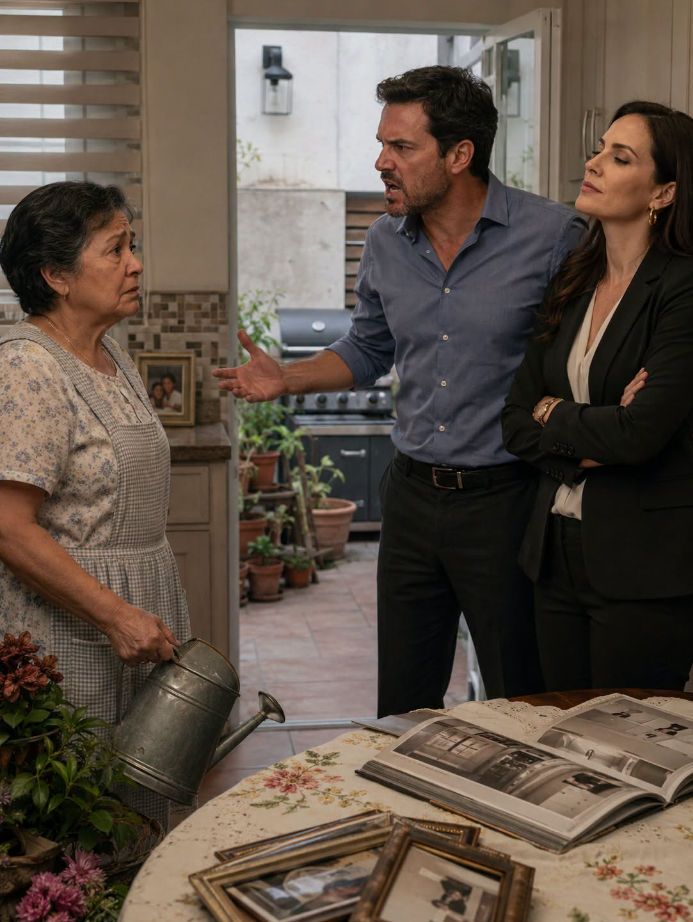
The house did not change overnight.
It changed the way slow storms change a landscape—quietly at first, until one day you cannot remember what it looked like before the wind.
I began noticing things I could not immediately prove.
A drawer left slightly open that I always closed. My sewing thread box moved from the living room shelf to a lower cabinet “so it looks cleaner.” The kitchen clock replaced without anyone asking me, even though the old one had been there since Gabriel was alive.
And then there were the plants.
The backyard was my sanctuary. Not large, not impressive—just a patch of soil I had built into life after Gabriel died. I could still remember him handing me the first rose cutting, saying, “This one will outlive me. Make sure you don’t let it die.”
I didn’t.
It became a small garden of memory.
So when I stepped outside one morning and saw three of my rose bushes dug up and placed in plastic bags by the shed, I felt something inside me go very still.
Cristina stood near the patio door holding a phone, speaking softly as if she were discussing something unimportant.
“They were blocking the sunlight for the new seating area,” she said without looking at me. “We’re going to put some modern landscaping instead. Gravel, maybe minimal plants. It’ll look more elegant.”
Elegant.
That word again.
As if warmth needed permission to exist.
I did not speak at first. I walked slowly toward the bags, my hands trembling not from age but from recognition—this was not rearrangement anymore. This was erasure.
“These roses were your father’s,” I said quietly.
Cristina finally looked at me.
Her expression did not soften. If anything, it sharpened slightly, as if my grief was an inconvenience she had not factored into her design.
“I know you’re sentimental, Mrs. Lucia,” she said. “But the backyard affects property value. Ricardo agrees it needs updating.”
Ricardo agrees.
That phrase had become a weapon in her mouth.
That evening, I waited for my son again.
He came home late, tie loosened, phone still in his hand. I showed him the bags outside.
“Son,” I said, trying to keep my voice steady, “those roses cannot be moved like furniture. They are dying out there.”
He sighed before I even finished speaking.
“Mom, it’s just landscaping,” he said. “Cris is trying to improve the house. You have to stop resisting every change.”
Every change.
As if the house were not my life.
As if my memories were obstacles.
I looked at him long enough that he finally glanced away.
Something shifted in me that night. Not anger yet. Something colder.
Clarity.
For months, I had been told I was difficult, emotional, outdated. I had been told I was misunderstanding, overreacting, misremembering my own home.
But I was not confused.
I was being replaced.
The next morning, I did something I had not done in years.
I called a lawyer.
Her name was Mrs. Delgado, a quiet woman with steel-gray hair and careful eyes. She listened without interrupting as I explained the house, the mortgage history, the years of payments, the documents I had kept in a folder older than my son’s marriage.
When I finished, she asked one question.
“Do they know the property is entirely in your name?”
“No,” I said.
She nodded slowly.
“Then you have been trying to negotiate with people who think they are equals in ownership.”
That sentence stayed with me on the drive home.
Equals in ownership.
When I returned, Cristina was in the kitchen reorganizing my spice cabinet again.
“Ricardo said we might host a dinner party next week,” she said casually. “I want the house to feel more… open.”
I placed my purse on the counter.
“This house,” I said, “is not open for redesign.”
She paused just long enough to show irritation.
“It’s not just your house anymore,” she replied.
I looked at her for a long moment.
“No,” I said quietly. “It never stopped being mine.”
That was the first time she looked unsettled.
Not afraid.
But calculating.
And that was more dangerous.
Chapter 3 — The House Remembers Its Owner (Final Chapter)
The confrontation came on a Sunday.
Sundays had once been sacred in my home. Gabriel used to say Sundays were for “keeping life human.” We would sit outside, drink coffee, and listen to the garden breathe.
That morning, the house felt wrong before I even opened my eyes.
Too quiet.
Too controlled.
When I stepped into the kitchen, I found strangers.
Again.
But this time, they were not Cristina’s friends.
They were workers—men carrying tools, measuring walls, speaking about “renovation timelines” as if the house had already agreed to be dismantled.
Cristina stood in the middle of it like a conductor.
“I told you I wanted the kitchen island expanded,” she said. “And these cabinets removed. We’ll need new flooring too.”
I felt my pulse slow.
“Stop,” I said.
The room went silent.
She turned slowly.
“Oh,” she said, as if I were an interruption rather than a person. “Mrs. Lucia. We were just discussing updates.”
“Updates,” I repeated.
Ricardo entered from behind her, rubbing his temples.
“Mom, we’re planning improvements,” he said tiredly. “Please don’t make this harder.”
I looked at my son.
And something inside me finally broke cleanly—not loudly, not violently. Just completely.
“This house is not under renovation,” I said.
Cristina smiled faintly.
“It will be,” she said. “Ricardo and I have already spoken to contractors. We’re investing in our future here.”
That word again.
Our.
I walked to the drawer where I kept my documents. My hands did not shake this time.
I placed the folder on the table.
“Read it,” I said.
Ricardo frowned. “Mom, what is this?”
“Open it.”
Cristina hesitated for the first time since she had entered my home.
Ricardo opened the folder.
I watched his face change as he read.
Confusion first.
Then disbelief.
Then something close to panic.
“This… this says the house is in your name only,” he said slowly.
“Yes,” I replied.
Silence.
Cristina stepped forward.
“That can’t be right,” she said quickly. “Ricardo helped with payments. We’ve been living here as a family.”
I looked at her.
“For six months,” I said.
Then I turned to my son.
“You lived here because I allowed it. Not because you owned anything.”
The air shifted.
Ricardo’s voice dropped.
“Why didn’t you tell us?”
I felt something ancient in me rise—not anger, not bitterness.
Truth.
“Because I wanted to believe I didn’t have to,” I said. “Because I thought my son would remember where he came from without needing paperwork to remind him.”
Cristina’s expression changed completely now.
The mask slipped.
“So what now?” she asked sharply. “You’re going to throw us out? After everything?”
Ricardo turned to her.
But for the first time, he did not defend her immediately.
He looked at the house.
At the plants she had moved.
At the cabinets she had replaced.
At the life she had overwritten.
Then he looked at me.
And something in his face finally cracked.
“Mom…” he said quietly. “I didn’t realize…”
“No,” I interrupted gently. “You didn’t.”
That silence lasted longer than any argument.
Cristina tried once more.
“You’re choosing your mother over your wife?” she said.
Ricardo did not answer immediately.
And that hesitation said everything.
I stepped forward.
“This is not about choosing,” I said. “This is about remembering.”
I walked past them into the backyard.
The roses were still there.
Not dead.
Not gone.
Just waiting.
I knelt beside them.
“I built this place before either of you decided who I was allowed to be inside it,” I said softly. “And I will not disappear from it.”
Behind me, I heard Cristina say something angry.
But Ricardo didn’t respond to her.
Not this time.
Epilogue — A House That Breathes Again
Two weeks later, Cristina moved out.
Not with drama. Not with shouting. With silence that tasted like defeat disguised as dignity.
Ricardo stayed—but something in him had changed. He spoke less, listened more. The sharpness in his voice softened into something closer to shame and understanding.
One afternoon, he came into the backyard and stood beside me.
“I didn’t protect you,” he said.
I didn’t look up immediately.
“I know,” I replied.
He swallowed.
“I thought I was building a family,” he said. “I didn’t realize I was letting someone erase you.”
I placed a hand on the soil.
“A family is not built by removing its foundation,” I said. “It is built by respecting it.”
He nodded slowly.
For a long time, we just stood there.
Then, without asking, he knelt beside me and helped replant the roses.
Not as the man who owned the house.
But as the son who finally remembered who built it.
May you like

And for the first time in months, the house did not feel like it was pushing me out.
It felt like it was breathing with me again.